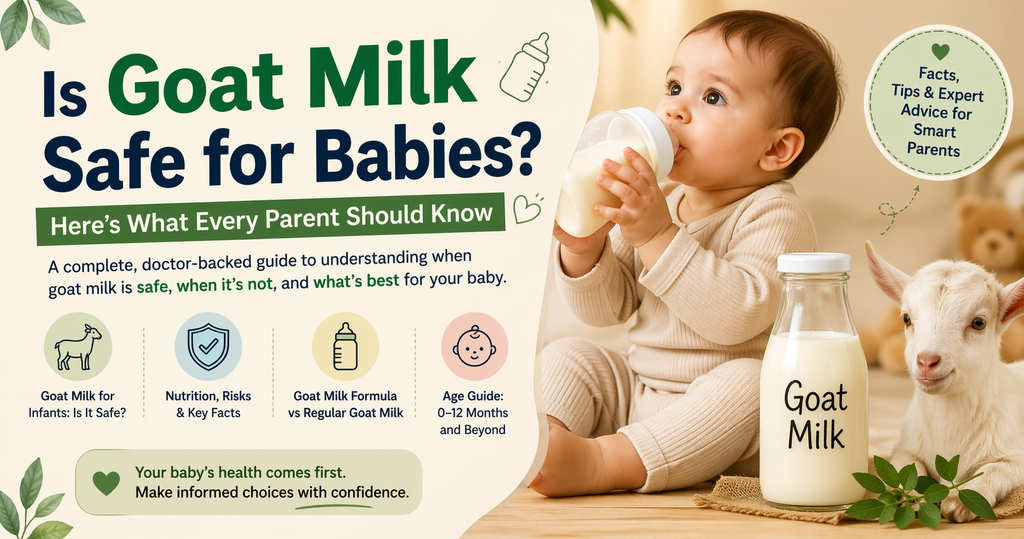
Is Goat Milk Safe for Babies? Here's What Every Parent Should Know

It's 2 a.m. Your baby won't settle. You've fed, burped, rocked, and Googled more than you'd like to admit. And somewhere between the fifth tab and the third cup of reheated chai, you land on goat milk.

Maybe a relative mentioned it. Maybe it came up in a parenting group. Maybe something about it just felt more natural, gentler somehow.

You're not alone in wondering.

So, Is Goat Milk Safe for Babies?

Let's answer this honestly and simply, because you deserve a straight answer, not a wall of disclaimers.

Regular goat milk is not safe for babies under 12 months. Not as a breast milk substitute, not as a formula top-up, not even occasionally.

Goat milk-based formula, recommended by a doctor, is a different matter. That can be appropriate for some infants but only under medical guidance.

More on each below.

Why Do Parents Even Think About Goat Milk?

It's worth understanding where this question comes from because it doesn't come from nowhere.

Goat milk has a long history in many cultures as a nourishing food. It's often described as easier to digest than cow's milk. Something is appealing about the idea of something closer to nature, less processed, less industrial-feeling.

And when your baby is uncomfortable, gassy, fussy, not sleeping it's completely natural to look for alternatives. That instinct to find something better, something gentler, is good parenting. It just needs a little steering.

Why Regular Goat Milk Isn't Right for Infants

The problem isn't that goat milk is bad. It's that a baby's digestive system and nutritional needs are extremely specific in the first year of life and regular goat milk doesn't meet them.

Here's what's missing or mismatched:

  • Too little folic acid: Goat milk is naturally low in it, which can lead to a type of anaemia called megaloblastic anaemia in babies.
  • Too little Vitamin B12: Another nutrient babies need and can't get enough of from goat milk alone.
  • Too much protein and minerals: This sounds like a good thing, but it isn't for a small baby. Their kidneys are still developing, and the mineral load in goat milk particularly sodium and potassium can put strain on them.

None of this is a flaw in goat milk itself. It's just not designed for newborns. Breast milk is. Infant formula is. Goat milk, as it comes, is not.

Goat Milk Formula Is Different

This is where things get nuanced, and it matters.

Goat milk formula is not the same as regular goat milk from a carton or packet. It's been formulated specifically for infants fortified with the vitamins babies actually need, and with protein and mineral levels adjusted to safer amounts. It's a different product entirely.

For babies who have difficulty tolerating standard cow's milk-based formula, goat milk formula can sometimes be an option but only when a paediatrician has assessed and recommended it. This isn't a product you pick off a shelf based on a hunch. It's a medical decision.

A Simple Age Guide

  • 0 to 12 months: Breast milk is the first choice. If that's not possible or sufficient, a doctor-recommended infant formula is the right path. Regular goat milk is not suitable at this stage.

  • 12 months and beyond: This is when whole goat milk can be introduced gradually alongside a varied diet, not as a replacement for meals. By this point, a toddler's kidneys are more developed and their nutritional needs have shifted.

A Few Things Worth Clearing Up

Goat milk is the closest thing to breast milk.

This comes up a lot, and it's not quite right. Human breast milk is uniquely matched to human babies it even adjusts in composition across feeds and across months. Goat milk is nutritionally quite different, lower in some key nutrients and higher in others. It's not a like-for-like comparison.

Goat milk is good for babies with allergies.

Some parents assume that if a baby reacts to cow's milk, goat milk will be fine. That's not always the case. The proteins in goat milk are similar enough to cow's milk that cross-reactivity can happen. If your baby has an allergy or intolerance, that conversation needs to happen with your doctor.

When the Time Is Right, Quality Matters

Once your child crosses 12 months and you want to bring goat milk into their diet, the next question is simply, Where does it come from, and how is it handled?

Not all goat milk is the same. Some is minimally processed, traceable, and tested. Some isn't. For a toddler, that difference matters. Look for something with clear sourcing, no unnecessary additives, and a producer that's transparent about how the milk travels from farm to bottle.

Conclusion

Parenting is full of moments where you're not sure if you're making the right call. That's not a failure. That's just how it works.

The fact that you're asking these questions checking what's in what your child eats, and wondering if there's something better means you're paying attention. That's most of the job.

Ask your doctor when things feel uncertain. Take things gradually. You don't need to have all the answers at 2 a.m.

Frequently Asked Questions

At what age can babies drink goat milk?

Babies can start drinking goat milk after 12 months of age. Before that, breast milk or infant formula is the safest and most suitable option.

Is goat milk closest to breast milk?

No. While goat milk is often considered easier to digest, it is not nutritionally similar to breast milk, which is specially designed for a baby’s needs.

Is goat milk good for autoimmune conditions?

There is no strong scientific evidence that goat milk helps with autoimmune diseases. It should not be used as a treatment.

Do pediatricians recommend goat milk formula?

Some pediatricians may recommend goat milk-based formula in specific cases, but only after evaluating the baby’s needs.

Can I give goat milk to my 1-year-old?

Yes, after 12 months, goat milk can be introduced in moderation, along with a balanced diet.

Is goat milk safe for infants under 1 year?

No. Regular goat milk is not safe for infants under 12 months due to nutritional imbalances.

How should I introduce goat milk to a 1-year-old?

Start with small quantities, offer it in a cup, and monitor for any reactions. It should complement meals, not replace them.

Is goat milk better than cow’s milk for babies?

Not necessarily. Both have similar proteins, and goat milk is not automatically safer or better for babies.

Can goat milk cause allergies in babies?

Yes. Babies allergic to cow’s milk may also react to goat milk due to similar proteins.


What are the risks of giving goat milk to babies?

Risks include low folic acid, low vitamin B12, and high mineral content, which can affect a baby’s health.

Related Articles

Is Goat Milk Safe for Babies? What Parents Must Know
Is Goat Milk Safe for Babies? Here's What...
How Every Bite Shapes Your Gut Health and Microbiome
How Every Bite Shapes Gut Health: What Your...
How Your Kitchen Supports Immune Health During Winter
How Your Kitchen Supports Immune Health During Winter...
The Connection Between Gut Health and Skin: What You Need to Know
Your Gut Is Talking to Your Skin: Here’s...
Why Is Goat Butter from Gujarat Yellow and Why Does It Matter?
Why Gujarat’s Goat Butter Is Yellow and Why...
Camel Milk in Ayurveda: From Desert Tradition to Modern Wellness
Camel Milk in Ayurveda Explained: Balancing Doshas, Boosting...
Sale Off
Goat Milk Powder
₹ 1,299.00₹ 1,249.00